By the IVS Travel Safety Editorial Team | Published: 13 August 2026 | Updated: 18 August 2026. Independent portal, not affiliated with the Government of Mozambique, VFS Global, or any embassy. Verify requirements at evisa.gov.mz and travel.state.gov.
The US State Department rates Mozambique at Level 2 (Exercise Increased Caution) in 2026, with Cabo Delgado under Do Not Travel due to terrorism. US tourists must obtain an eVisa via VFS Global (launched 11 February 2026), with ETA recommended at least 48 hours before departure. Yellow fever vaccination, malaria prophylaxis, and travel insurance with medical evacuation are essential. The Mozambique eVisa travel advisory 2026 also flags kidnapping in Maputo, Sofala, and Cabo Delgado, armed robbery and car-jackings as common crimes, and cyclone season from November to April.
Travel Advisories & Regional Safety Risks in Mozambique 2026
The US State Department rates Mozambique at Level 2: Exercise Increased Caution, while Australia’s smartraveller.gov.au advises a “high degree of caution” (updated 18 August 2026). The Mozambique eVisa travel advisory 2026 designates Cabo Delgado and Nampula’s Erati and Memba districts as Do Not Travel zones due to terrorism, kidnapping, and armed clashes. Niassa’s Marrupa and Mecula districts carry a Reconsider Travel rating. Terrorists target foreign nationals and areas where foreign companies operate.
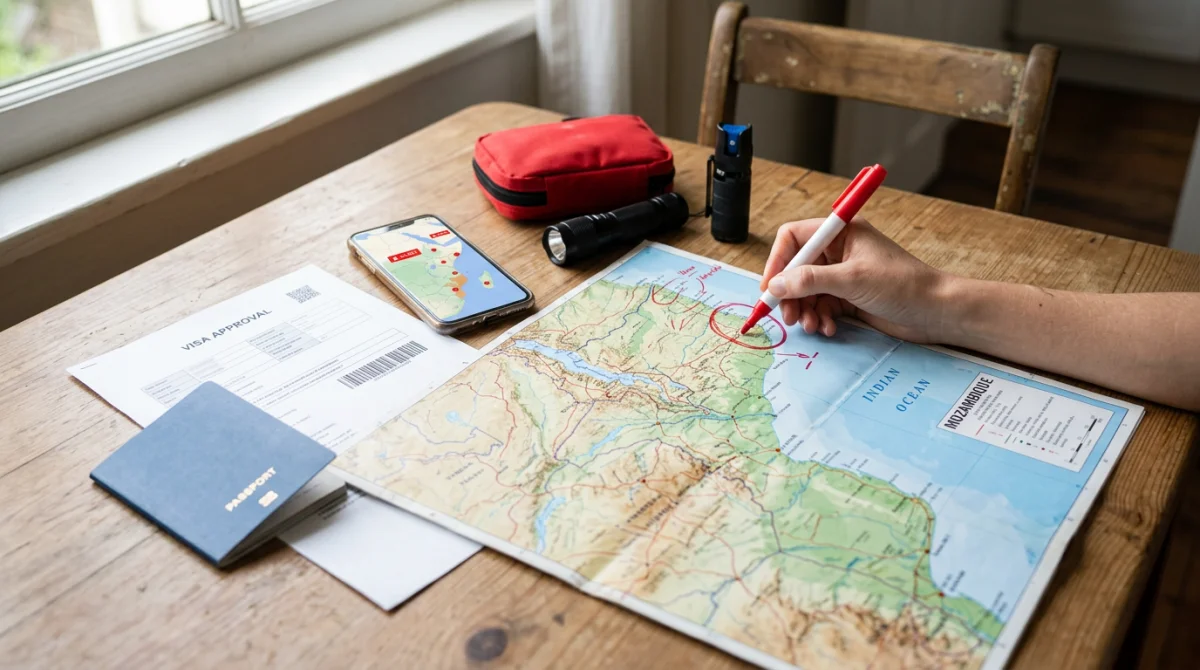
Armed robbery, break-ins, car-jackings, and bag snatching are classified as common by smartraveller.gov.au, with elevated risk at night and during holidays. Drink spiking and methanol poisoning from local spirits pose additional threats. Violent attacks and sexual assaults can occur. Avoid all protests and demonstrations. Download the TravelSafe SOS app for real-time alerts.
| Region | Risk Level | Primary Threat |
|---|---|---|
| Cabo Delgado | Do Not Travel | Terrorism, kidnapping, armed clashes |
| Nampula (Erati, Memba) | Do Not Travel | Terrorism, insurgency |
| Niassa (Marrupa, Mecula) | Reconsider Travel | Terrorism, violent crime, kidnapping |
| EN1 (Save-Muxungue, Gorongosa-Caia) | Do Not Travel | Armed attacks on vehicles |
| EN6 (Beira-Chimoio) | Do Not Travel | Armed attacks on vehicles |
| Maputo | Exercise Caution | Street crime, bag snatching |
| Bazaruto, Inhambane | Generally Safe | Low risk, standard precautions |
Given these threats, plan itineraries around safe zones and avoid the EN1 and EN6 conflict corridors. Fly LAM to Vilanculos instead of driving EN1. The Mozambique eVisa travel advisory 2026 recommends monitoring updates via travel.state.gov before departure.
Health Precautions & Vaccinations for Mozambique 2026
Malaria is a year-round risk outside Maputo. Prophylaxis with Malarone, Doxycycline, or Mefloquine should start two weeks before departure and continue during and after the trip. The Mozambique eVisa travel advisory 2026 confirms mosquito-borne dengue, lymphatic filariasis, and African sleeping sickness, plus waterborne cholera, hepatitis, schistosomiasis, and tuberculosis. HIV/AIDS risk is high, and Mpox is present in Mozambique. Use insect repellent and stay in insect-proof accommodation.
| Vaccine | Status | Timing | US Cost Estimate |
|---|---|---|---|
| Yellow Fever | Required (if from endemic country) | 10 days before travel | $200-250 |
| Hepatitis A | Recommended | 2 weeks before | $80-120 |
| Hepatitis B | Recommended | 4 weeks before | $60-120 |
| Typhoid | Recommended | 2 weeks before | $50-100 |
| Meningitis | Recommended | 2 weeks before | $130-160 |
| Rabies | Recommended | 4 weeks before | – |
Per the CDC Yellow Book and WHO International Travel & Health recommendations, complete vaccinations 12 weeks ahead. Cyclone season runs November to April; storms Idai (2019) and Freddy (2022) caused severe damage, flooding, and travel disruptions. Monitor the JTWC and Mozambique’s INAM alerts. Carry waterproof gear and offline maps. These precautions are essential before applying for entry under the Mozambique eVisa travel advisory 2026.
Mozambique eVisa & ETA Requirements for US Travelers 2026
US citizens apply through the VFS Global platform (launched 11 February 2026), requiring a passport valid 6 months beyond entry and a 650 MZN (approx. 10 USD) entry tax. The Mozambique eVisa travel advisory 2026 offers two options: the eVisa (max 90 days, full visa) and the Electronic Travel Authorization (ETA) (max 30 days, pre-travel authorization for visa-exempt nationals, not a visa). The ETA was suspended 16 March 2025 and relaunched 11 February 2026. Apply at least 48 hours before departure. Visa on arrival (max 30 days, 50 USD) exists but should not be relied on.
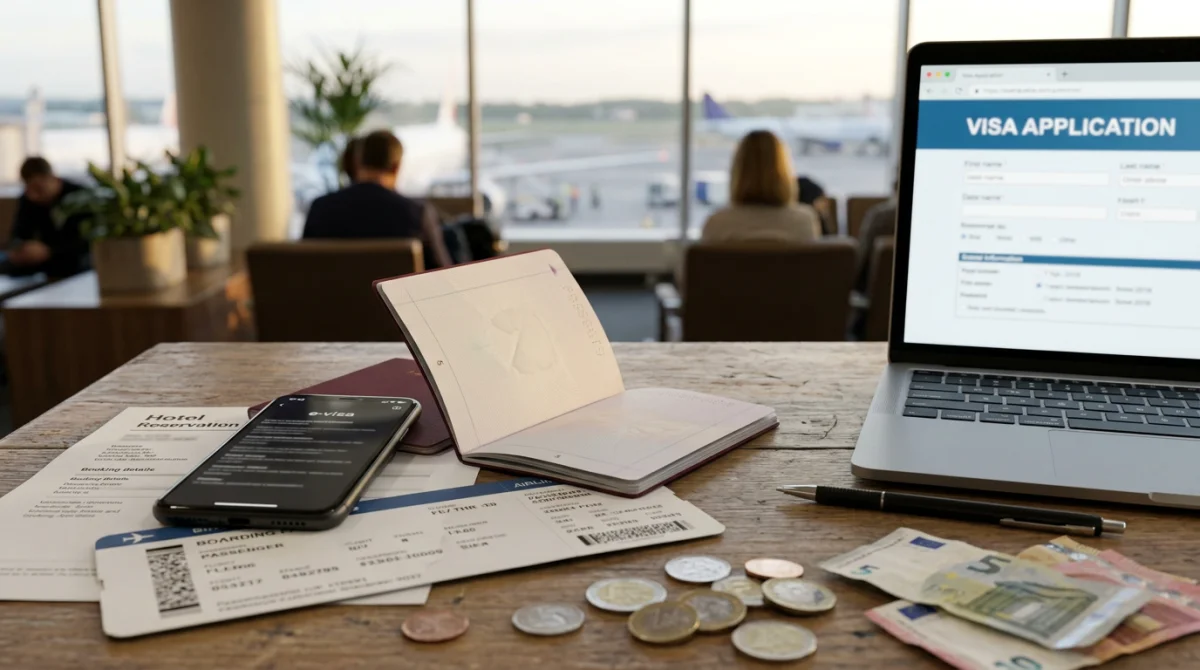
- Fill the online form on the external government portal evisa.gov.mz
- Upload documents: passport copy, photo, proof of accommodation, return ticket, sufficient funds
- Pay online and receive your eVisa (standard: 7-10 working days; express: 5-7 working days, additional fee)
Passport: 2 blank pages, 6-month validity, return or onward ticket. Minors under 18: birth certificate + parental consent if not with both parents. A one-time 30-day visa extension is possible at immigration offices at officers’ discretion. Transit passengers (max 24 hours in transit area) are visa-exempt. Countries not eligible for eVisa: Pakistan, Bangladesh, Ethiopia, Nigeria, Nepal, Somalia (apply at nearest embassy). SADC member states enjoy visa-free stays of 30-90 days. Dual nationals must use the passport they will travel with. Verify documentation per the Mozambique eVisa travel advisory 2026.
Visa Scams & Fraudulent Websites
Only use the Mozambique eVisa portal at evisa.gov.mz or verified government links. Be wary of sites charging excessive fees or requesting unnecessary personal information. The legitimate platform is operated by VFS Global for the National Immigration Service. If you suspect a scam, contact the US Embassy in Maputo and reference the Mozambique eVisa travel advisory 2026 for guidance on legitimate application channels.
Practical Travel Essentials & Preparation Timeline 2026
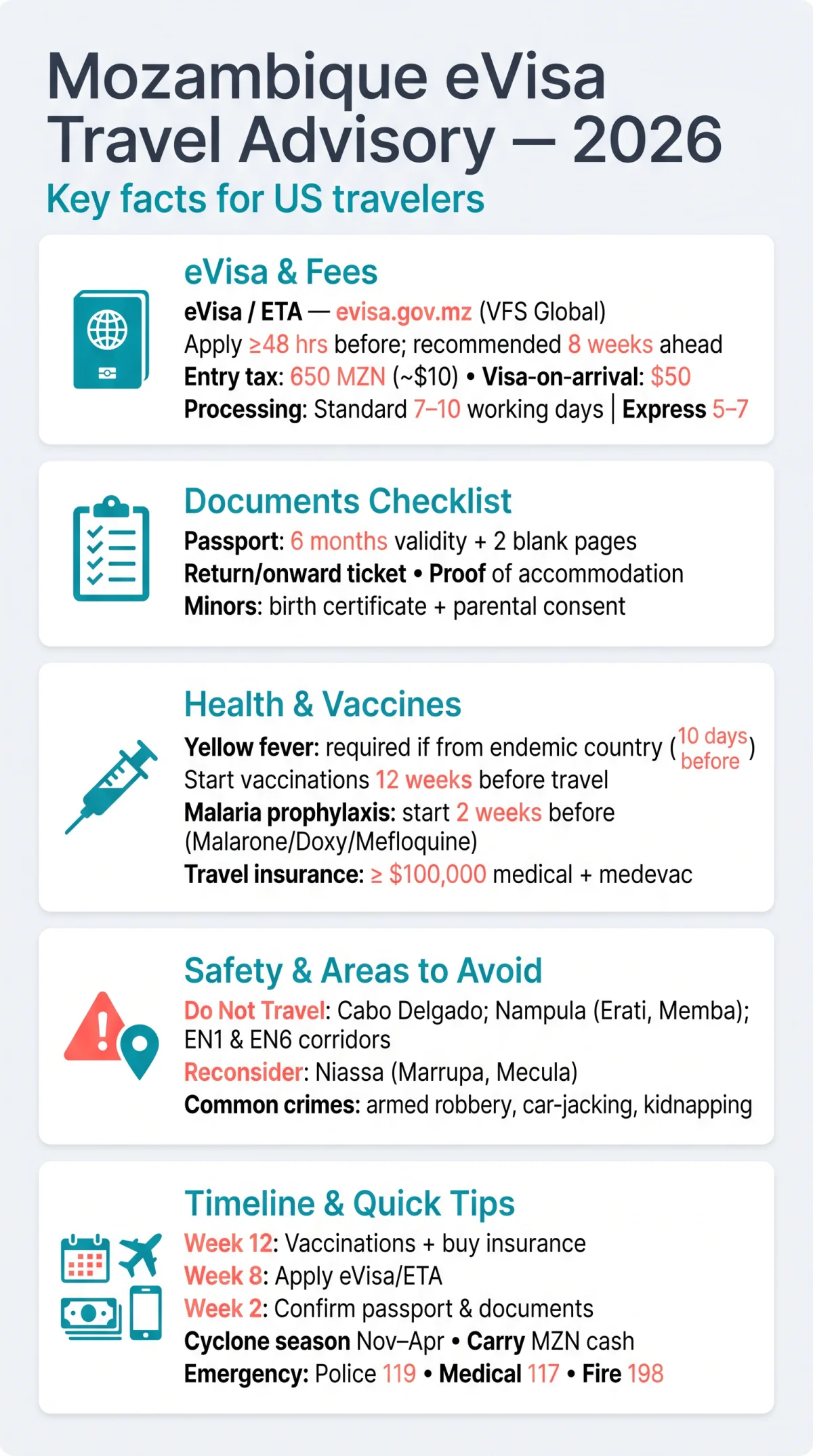
The Mozambique eVisa travel advisory 2026 recommends starting vaccinations 12 weeks ahead and applying for the eVisa at least 8 weeks before departure.
- Week 12: Obtain vaccinations and purchase travel insurance with minimum $100K medical coverage plus evacuation to South Africa; verify war-zone exclusions for Cabo Delgado.
- Week 8: Apply for your eVisa or ETA through evisa.gov.mz (VFS Global, launched 11 February 2026); allow 7-10 working days standard or 5-7 working days express (additional fee).
- Week 4: Re-check advisory updates on travel.state.gov and download the TravelSafe SOS app.
- Week 2: Confirm documents: passport with 6-month validity and 2 blank pages, return ticket, proof of accommodation.
Travel Insurance Recommendations
Ensure at least $100,000 medical coverage and emergency evacuation to South Africa. Some policies exclude terrorism in Cabo Delgado, so check war-zone exclusions. Health infrastructure outside Maputo is limited, making evacuation coverage critical. The Mozambique eVisa travel advisory 2026 recommends verifying your policy covers Mozambique specifically before applying for your eVisa.
Carry MZN cash (ATMs scarce in rural areas). Portuguese is the official language; English is limited outside tourist zones. Power outlets: Type C/F, 220V. Emergency numbers: fire 198, medical 117, police 119. Register with the US Embassy in Maputo before departure.
Mozambique eVisa Travel Advisory 2026: FAQ
Is Mozambique safe for tourists in 2026?
Mozambique is generally safe in tourist areas, but the US State Department advises Level 2 (Exercise Increased Caution). Avoid Cabo Delgado and Nampula’s Erati and Memba districts due to terrorism. Check the latest Mozambique eVisa travel advisory 2026 updates via travel.state.gov.
What vaccinations do I need for Mozambique in 2026?
Yellow fever is required if arriving from an endemic country. Hepatitis A, B, typhoid, meningitis, and rabies are recommended. Malaria prophylaxis is essential year-round outside Maputo. Consult your doctor for Malarone, Doxycycline, or Mefloquine per CDC Yellow Book guidelines.
How do I apply for a Mozambique eVisa in 2026?
Apply through the VFS Global platform (launched 11 February 2026). ETA recommended at least 48 hours before travel. Passport needs 6-month validity and 2 blank pages. Standard: 7-10 days; express: 5-7 days. Entry tax: 650 MZN (approx. 10 USD) per the Mozambique eVisa travel advisory 2026.
What areas of Mozambique should I avoid in 2026?
Avoid Cabo Delgado (terrorism), Nampula Erati and Memba (insurgency), and Niassa Marrupa and Mecula (reconsider travel). The EN1 (Save-Muxungue, Gorongosa-Caia) and EN6 (Beira-Chimoio) are Do Not Travel zones due to armed attacks on vehicles.
How do I avoid Mozambique eVisa scams?
Only use evisa.gov.mz or verified government links. Be wary of sites charging excessive fees or requesting unnecessary personal information. If you suspect a scam, contact the US Embassy in Maputo. The legitimate platform is operated by VFS Global.
What is the cyclone season in Mozambique?
Cyclone season runs November to April. Prepare with waterproof gear, offline maps, and monitor alerts from JTWC and Mozambique INAM. Historical cyclones 2019 Idai and 2022 Freddy caused significant damage and flooding.
Do I need travel insurance for Mozambique?
Yes. Ensure at least $100,000 medical coverage and emergency evacuation to South Africa. Some policies exclude terrorism in Cabo Delgado, so check war-zone exclusions. Health infrastructure outside Maputo is limited.
What documents do I need to enter Mozambique as a US tourist?
Valid passport (6-month validity, 2 blank pages), eVisa or ETA approval, return or onward ticket, proof of accommodation, and entry tax (650 MZN). Minors under 18: birth certificate and notarized parental consent if traveling without one or both parents.